


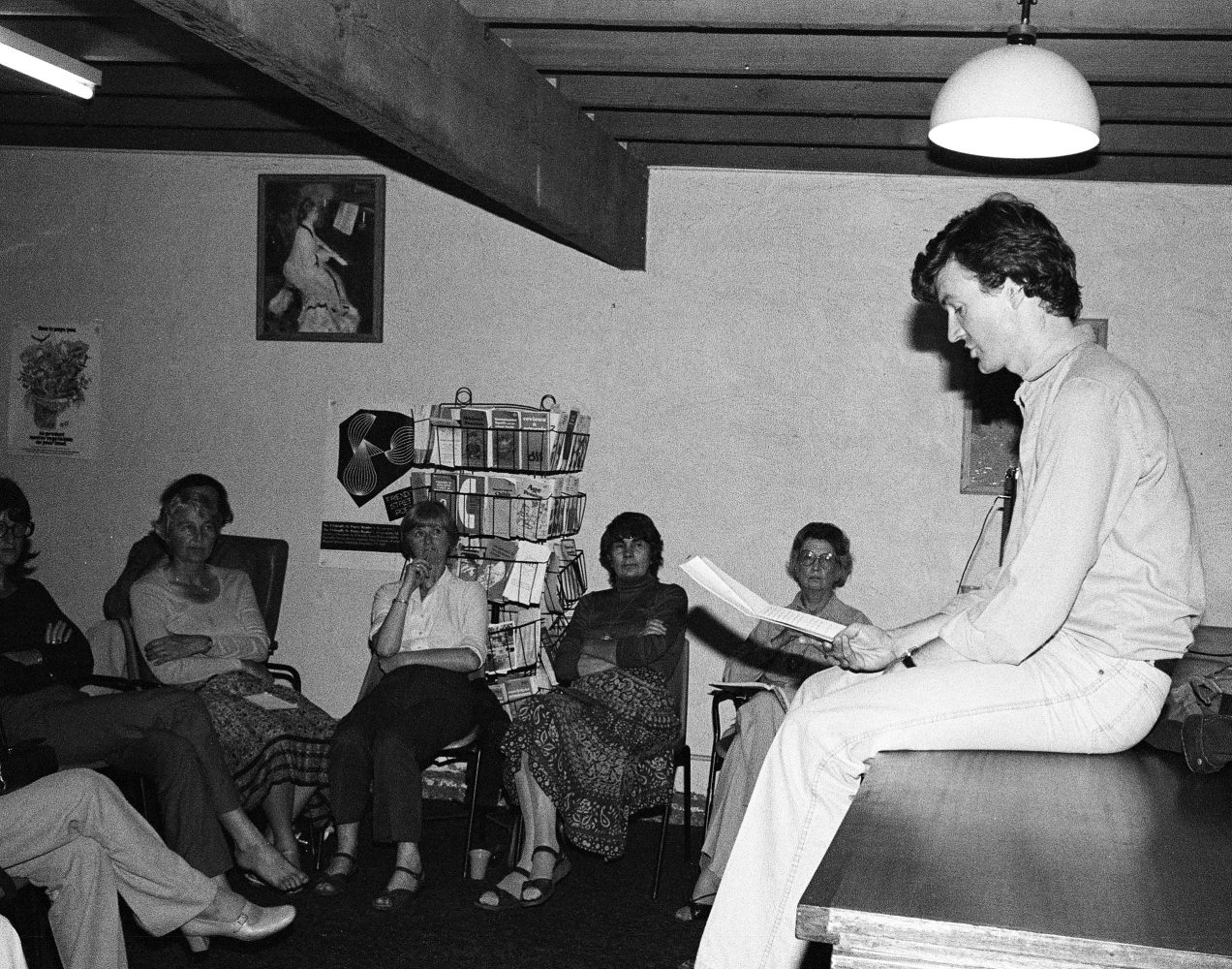
Friendly Street is the longest running poetry reading in the Southern Hemisphere. Established in 1975, the collective has now been hosting regular monthly events in Adelaide for over fifty years. Typically, evening activities comprise poetry readings by established poets, followed by an ‘open mic’ when anyone is welcome to read their work. The poet Vincent Buckley once declared Friendly Street ‘the best poetry reading in Australia’, while acclaimed author, Geoffrey Dutton, asserted that Friendly Street has ‘probably done more for poetry in Australia than any other group’. In addition to a vibrant community culture which has fostered many well-known South Australian writers, Friendly Street oversees four poetry prizes as well we regular poetry events across schools and regional South Australia. Friendly Street’s unique contribution to South Australia’s cultural life can be traced through the anthologies published annually since 1977, while its unique social history has been documented in: Tuesday Night Live: Fifteen Years of Friendly Street (1993), Best of Friends: The First Thirty Years of Friendly Street Poets (2008) and Chronicle: The First Fifty Years of Friendly Street (2025 and 2026).
Origins
South Australia has a proud literary history. As well as inspiring avant-garde literary movements such as the Jindyworobaks and Angry Penguins, Adelaide was the first Australian capital to have a Writers’ Week and a Writers’ Centre.
University of Adelaide poets, Ian Reid and Andrew Taylor first discussed the idea of initiating a regular poetry reading in Adelaide after returning from America in the early 1970s. Both had been inspired by the literary activities they witnessed there in ‘public spaces, not just literary salons’. The two poets discussed the idea with Richard Tipping who proposed the name ‘Friendly Street’ to evoke ‘the generosity of poets towards each other’. ‘The street itself does not exist and has never existed, and yet’, as Christopher Bantick observed, ‘it appears in the Oxford Literary Guide to Australia and taxi drivers seem to know where to find it.’
A location was nonetheless found for the first reading, which occurred at Gordon Choon’s Fireworks Factory (aka Media Resource Centre) in the north-east corner of Adelaide. The old factory had the ‘charm of an old industrial building, with well-trodden floorboards and a small rooftop terrace’. Taylor recalls that the evening of that first event, 11 November 1975, ‘was one of those blue, blazing evenings’. It was also the day Gough Whitlam’s Labor Government was dismissed by Governor-General, Sir John Robert Kerr, AK, GCMG, GCVO, QC. As the political climate was foremost in many minds, the organisers feared no one would turn up. But, by 8pm, people were:
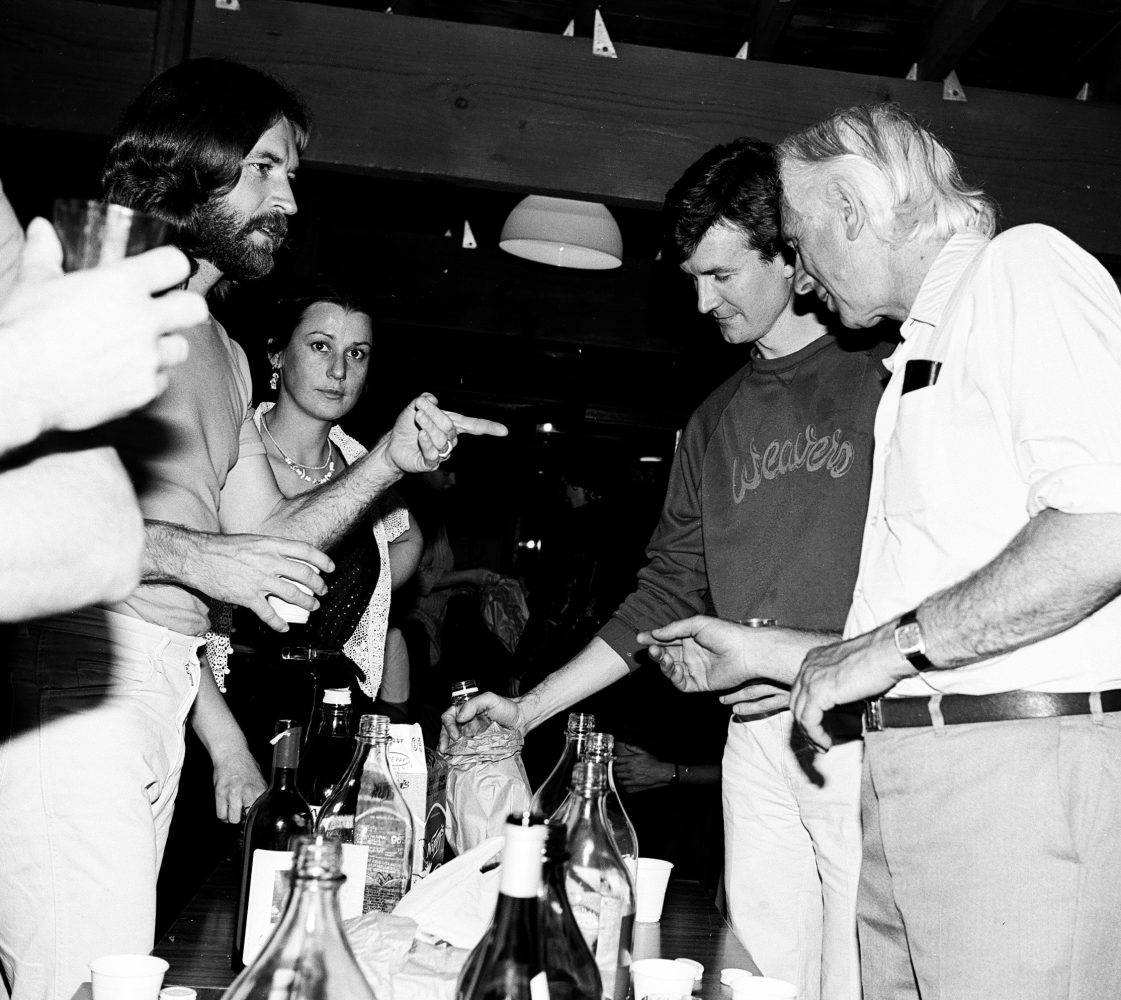
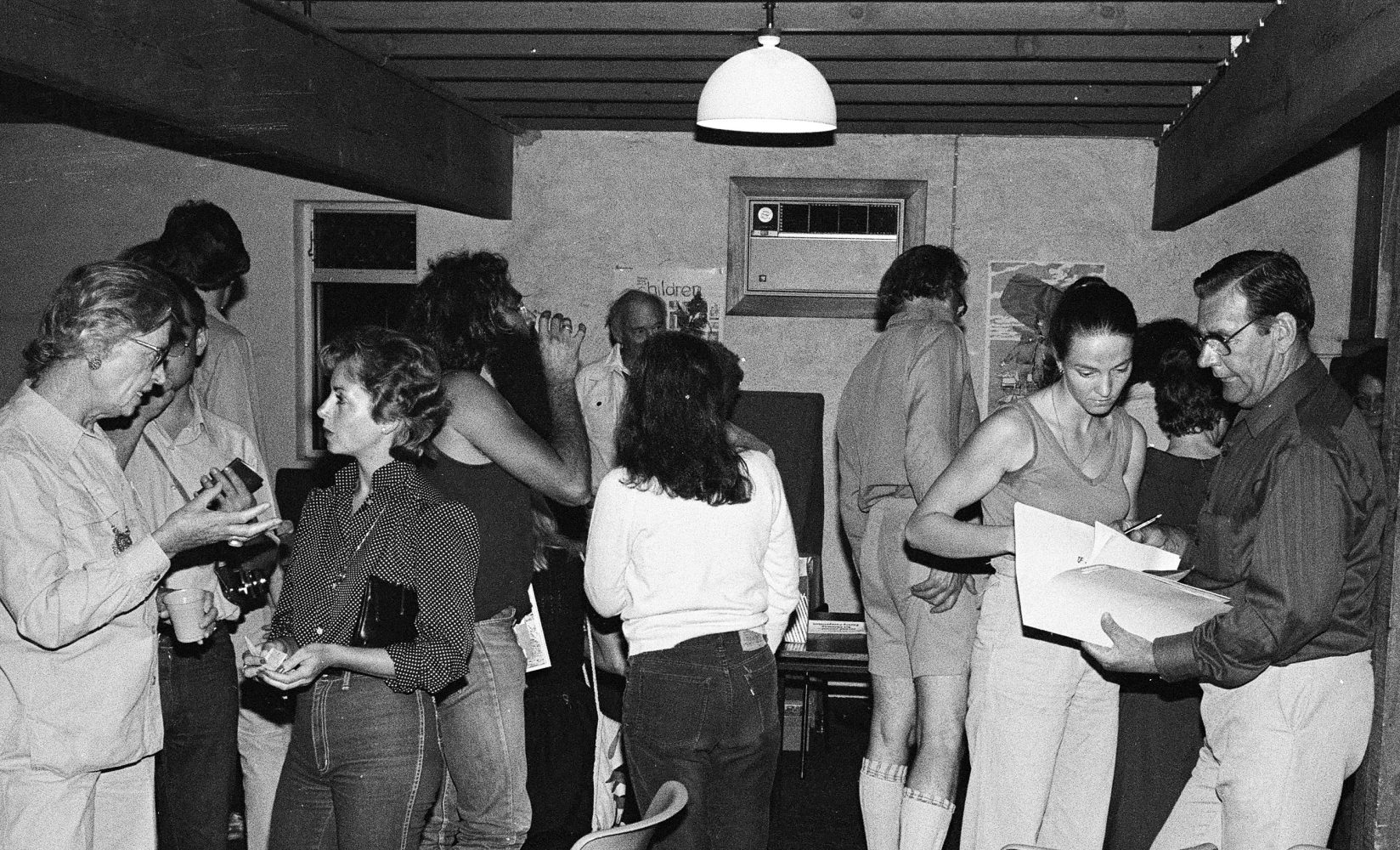
‘ … draped around the cramped space, sitting on tables, leaning back on chairs or crouched and sprawled on the floor. The contents of wine flagons steadily receding, smokers everywhere, a total buzz — everyone intent and in the moment … a real community of artists, involved in that solitary and mostly unacknowledged art form — poetry. Sharing, barracking, but most all, listening, carefully, giving each writer their due, honouring the collective. There were a few raucous dissensions and very occasional heckling from the back — after all, it was a fireworks factory.’
A protocol soon developed to manage the ‘open-mic literary fireworks’ which proved ‘admirably practicable and enduring’. The founding fathers and mothers:
‘… set up a logbook for eager poets to form a tidy queue and not squabble for pole position. There would be a guest first reader (mostly one of the regulars) and then, after a break for libations, an open mic for the others. But in strict order, and with a limit of three minutes each’.
In the early years, ‘the freewheeling poet’, Richard Tipping, frequently served as timekeeper, often brandishing a starting pistol if anyone read too long’. In 1977, Friendly Street moved to The Box Factory, 59 Regent Street, Adelaide. Peter Armstrong recalls attending one evening in 1979:
The table near the door fills up with casks and flagons, and the seats and floor fill up quickly. An elderly, grey-suited gentleman sits next to a trench-coated student; a guru-type sits cross-legged on the pool table; someone tunes his guitar; a handful of matric students out for a night on the town …’
Between 1977 to 2003, Friendly Street was based at the Box Factory and passions in this ‘fractious … but … always supportive community’ often ran high, occasionally escalating in a punch up, fuelled by the flagons of ‘rough red and acidic white’, which then flowed freely. Tipping likened this anarchic energy to ‘a shoebox full of grasshoppers’, but Friendly Street quickly established itself as ‘the place where ‘the newest and most tentative things were tried out’. Two South Australian premiers, Don Dunstan and Mike Rann, attended events, while the audiences regularly exceeded 100.
The introduction of the breathalyser in 1981, which mandated maximum alcohol levels for drivers, apparently did much to change ‘the temperature of the readings’. A certain frisson nonetheless remained, as David Myers recalls in his poem, Friendly Street: or The Proletarian Poets’ Roller Skate Derby, (1982):
Is this a pisspots’ bedlam?
Or do I spy through the nicotine smog
the proletarian muse of poetry in pink mohawk and striped socks
doing way-out wheelies on roller skates?
Many performers were well-known writers, including Geoffrey Dutton, Former Chief Justice, Dr John Bray (AC QC), distinguished lawyer, Robert Clark and his wife Dorothy, Peter Porter and Colin Thiele. Visiting poets from other Australian states include Les Murray, Bruce Dawe, Jamie Grant, Mark Strand, Robert Duncan, Kevin Roberts, Les Murray, πO, Kate Jennings and ‘the wonderfully anarchic eric beach’. Friendly Street also welcomed eminent international writers, Ted Hughes, Margaret Atwood, Robert Duncan and Galway Kinnell, John Willett, Roger McGough, Brian Patten, Adrian Mitchell, Kevin Roberts and scientist, Miroslav Holub. By the 1990s, as Friendly Street attendee, John Bray, observed: ‘most of the poets … flourishing in South Australia have been published at one time or another by Friendly Street’. In fact, it had become ‘a point of prestige for the aspiring poet to read there, even if he or she was not selected for the anthology.’
Since then, Friendly Street has remained true to its ‘democratic and mercurial’ spirit, as well as its essential mission: ‘to provide a venue for novice and established writers to perform their work in front of engaged audiences’. As Jeri Kroll, another regular, recalls, Friendly Street has always welcomed ‘the beginning writer, the mentally troubled and sometimes the homeless. All were accepted and had equal time ‘in the sun’. Memorable performances have included a magician, a stilt-walker and a pole dancing poet. Works have been accompanied by drums, jaw harps, kalimbas, clarinets and zithers, while audiences have been entertained by the fiddler from the folk-rock band, Red Gum, the celebrated musician, Paul Kelly and poets dressed in top hats, silver-space suits and Ned Kelly armour.
In 2003, the Adelaide City Council declared the Box Factory a health hazard, so Friendly Street relocated to the Atrium room at the SA Writers’ Centre in Rundle Street. During this period, artists, Hossain Valamanesh, originally from Tehran, and Daisybell Virgin, a student at Tauondi Aboriginal College, were both commissioned to produce cover artwork for Friendly Street’s annual anthologies. South Australia’s cultural diversity became increasingly evident within the collective, as poets with Indian heritage such as Nitu Banerji, and others with Singaporean, Lebanese, Palestinian, Lithuanian, Romanian and Greek backgrounds became regular participants.
In 2007, renovations at the Box Factory were completed, allowing Friendly Street to return and make to their ‘forever home’. However, many, including Jude Aquilina, mourned the ‘gradual taming’ of events associated with the new prohibition of drinking and smoking:
I miss the rank smoke at Friendly Street
wafting in from the balcony, the glazed poets
reciting with gusto and pauses of forgetting.
I miss the casks of red and white …
Throughout the 2000s, Friendly Street has continued to explore a diversity of genres and topics, accompanied by a growing appreciation for environmental poetry and high energy slams involving young poets.
Schools
In the early 1970s, Friendly Street benefited from a new education policy, which led to dramatic change across South Australia’s schools. ‘The Freedom and Authority Memorandum’, as it became known, sought to decentralise and reform South Australian schools, allowing teachers a more active role in curriculum development. Friendly Street poet, Rory Harris, collaborated with teachers, Erica Jolly and Peter McFarlane, both working in the South Australian public school system. Together, they introduced high school students to a vibrant and inclusive live poetry scene which led many young people to become writers.
Between 1976 and 1983, Friendly Street and SAETA developed the ‘Poetry in Schools Movement’, which influenced the curriculum and enhanced the poetry content of Opinion, the South Australian English Teachers Association (SAETA) Journal. During this period, Harris was awarded a poet-in-residence and delivered hundreds of Poetry Workshops across South Australian High Schools. In 1977 McFarlane established the Spring Poetry Festival: an annual celebration of poems by South Australia’s school students. Since then, the connection between SAETA and Friendly Street has been strengthened by inviting students, with poetry published in the Spring Poetry anthology, to read at Friendly Street.
Regional Engagement
‘… a carload of we aspiring poets, when we could afford the money and the time from farm-work and off-farm jobs, would come down to the Big Smoke to participate’.
Over the years, regional South Australian poets have driven hundreds of kilometres to attend Friendly Street’s monthly readings in Adelaide. For many, the experience was transformative, providing them with constructive feedback and the confidence to develop their work. More recently, Friendly Street regularly Nigel Ford has collaborated with regional writers to support regular poetry readings in Gawler and Goolwa, Murray Bridge and Milang, Port Noarlunga and Port Augusta.
Friendly Street Today
‘Friendly Street, or Amicable Avenue as some wags call it, is a Remarkable Road, a Tantalising Terrace, and above all, an Adelaide Institution.’
Since its heady beginnings in 1975, Friendly Street has survived ‘the occasional fracas’, to become ‘a multigenerational extended family’, which is now well-recognised as ‘the tap root of the South Australian poetry scene’.
In its 50th year in 2025, Friendly Street poets celebrated with a ‘Love-In’ at the Box Factory, a reunion dinner, and two anniversary regional poetry slams. Monthly readings continue to attract solid audiences and new poets. Given that ‘poets tend to be solitary, unsociable, free thinking, contrary, secretive and stubborn’, the fact that this collective has lasted so long is generally considered ‘nothing short of a minor miracle’.
For performance poet, Avalanche, aka Ivan Rehorek, Friendly Street has always been ‘belonging’ and ‘the beauty of the word …’ Thus, as Kroll and Ford reflect, this ‘much-loved institution’ has become ‘a never-ending reading’, and ‘the poem’, that is Friendly Street, shall go on, ‘year after year. There’s no end in sight’.
Prizes
Friendly Street hosts four poetry prizes:
· The Satura prize, established in 1995, in memory of Chief Justice, Dr John Bray.
· The Nova prize, established in 2004, recognising a new poet from the annual anthology.
· The editors of the annual Friendly Street anthology award senior school submissions to SAETA’s annual Spring Poetry Festival since 1978.
· The Khail Jureidini Award, established in 2025 for ‘poem of the month’.
Publications
As of 2025, ‘Friendly Street Poets have published over 100 poetry books. In addition to Individual Collections and the Friendly Street New Poet Series, this includes the annual anthology, the Friendly Street Reader. See Chronicle ‘Appendix 1: Publications by Friendly Street Poets’.

Comments